


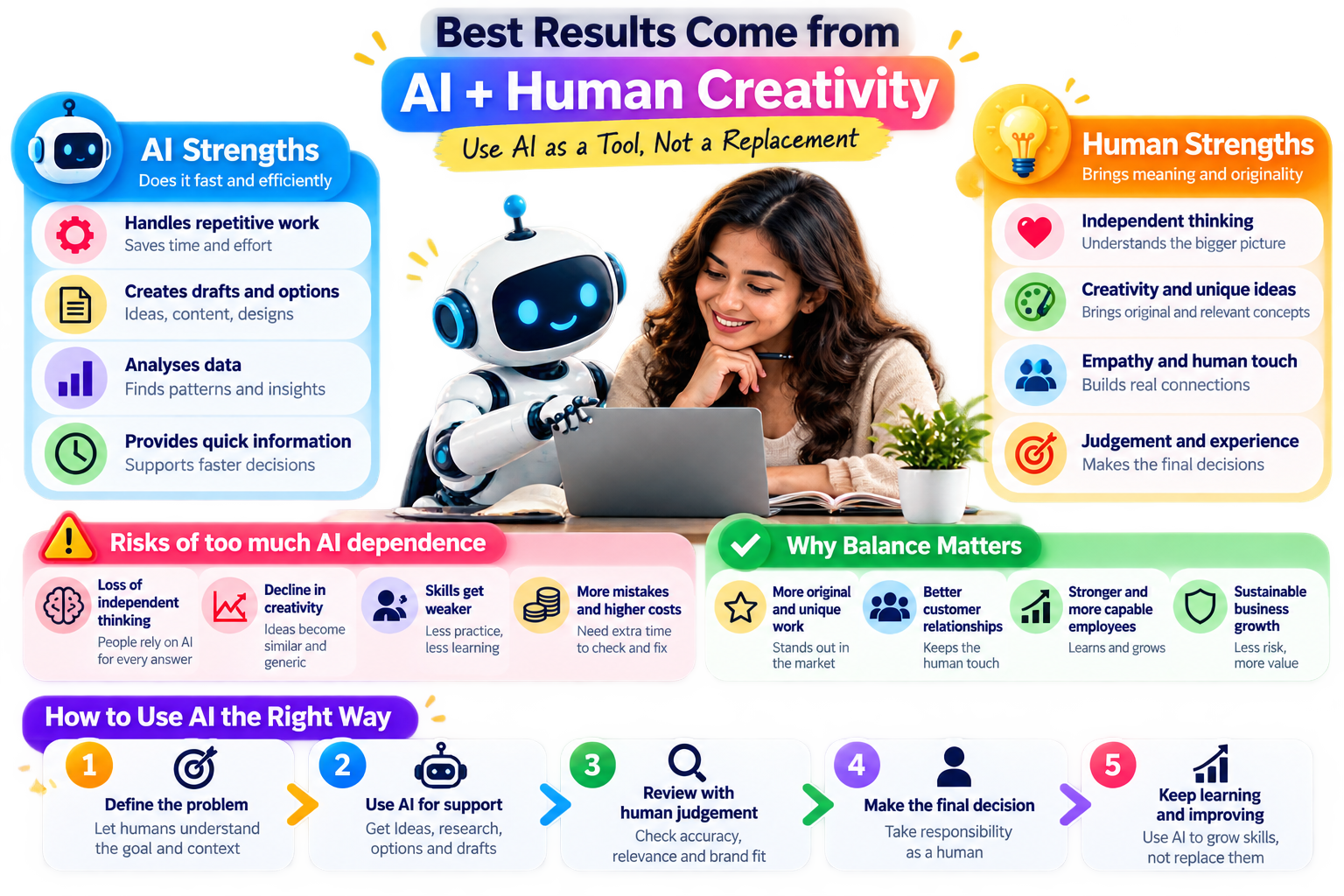
An honest perspective on business productivity, employee development, creativity, customer relationships, and the future of work.
Introduction: When a Tool Starts Doing Our Thinking
Artificial intelligence has become one of the most powerful tools available to modern businesses. It can write content, analyse information, generate designs, automate repetitive tasks, support customer service, and help employees complete work in a fraction of the time it once required.
For businesses operating in competitive markets, ignoring AI may mean missing valuable opportunities. But adopting it without clear boundaries presents another risk: gradually losing the very human capabilities that make a business distinctive.
The question is no longer whether businesses should use AI. The more important question is how much should we depend on it before we begin compromising our own ability to think, create, judge, and connect with people?
AI can help explain, generate, analyse, and organise information. However, It do not experience a customer’s disappointment, an employee’s frustration, a founder’s uncertainty, or the personal responsibility of making a difficult business decision. It can produce a convincing description of these experiences without having lived them.
That distinction matters.
AI can contribute to human work, but producing an answer is not the same as understanding a situation through lived experience. Businesses need to recognise this difference before efficiency becomes their only measure of success.
1. AI Dependency Is Different from AI Adoption
Using AI does not automatically make a business dependent on it. Dependency begins when people gradually lose the confidence, knowledge, or willingness to perform essential tasks without assistance.
Consider two employees working on the same marketing campaign.
The first employee studies the audience, understands the product, develops a concept, and uses AI to explore alternatives, improve the wording, and check the final work.
The second employee asks AI to identify the audience, develop the strategy, generate the content, select the creative direction, and decide what should be published. The employee reviews the output quickly and forwards it to the client.
Both employees use AI. However, their relationship with the technology is fundamentally different.
The first employee uses AI to strengthen their capabilities. The second risks allowing AI to replace the thinking that develops those capabilities.
This distinction becomes especially important when the second approach turns into a routine. If an employee repeatedly delegates the same mental tasks, they may get faster at producing outputs without becoming better at understanding the work behind them.
That outcome is not inevitable. AI can also help people learn new skills. The risk arises when assistance becomes a substitute for practice, rather than a way to improve it.
2. The Hidden Business Damage of Excessive AI Dependence
The immediate benefits of AI are often visible: fewer working hours, faster drafts, lower production costs, and more output. The potential damage is less visible because it accumulates over time.
Loss of independent thinking
If employees consult AI before attempting to solve every problem themselves, they may become less comfortable working through uncertainty.
Instead of asking, “What do I think is happening, and why?”, they may begin asking, “What does AI say is happening?”
AI-generated explanations can sound authoritative even when they are incomplete or incorrect. Employees who lack the knowledge to evaluate those explanations may accept weak recommendations with confidence.
Over time, this can weaken a company’s internal problem-solving capacity. When an unusual situation arises, the team may struggle because it has become accustomed to receiving answers rather than developing them.
Declining originality and creative differentiation
AI systems can generate an impressive range of ideas, but their outputs often reflect recognisable patterns in the material on which they were trained and the instructions they receive.
When competing businesses use similar tools, similar prompts, and similar approaches, their content can begin to look and sound alike.
Websites may use the same persuasive phrases. Advertisements may repeat familiar emotional appeals. Brands may adopt similar visual styles, headlines, and promises.
The problem is not that AI cannot produce original or surprising work. It can. The problem is that convenient, acceptable outputs can discourage people from exploring more difficult, unusual, or locally relevant ideas.
Creativity is not simply the ability to produce more ideas. It is also the ability to recognise which ideas are worth pursuing, challenge familiar assumptions, and express something meaningful that competitors have overlooked.
A business that produces more content but develops less distinctive thinking may become more productive in volume while becoming less recognisable in the market.
Loss of practical expertise
A junior employee learns by doing, making mistakes, receiving feedback, and correcting their work. A designer develops judgement by studying composition, typography, user behaviour, and visual hierarchy. A marketer learns by testing campaigns, interpreting results, and understanding why audiences respond differently.
If AI performs the difficult parts of these tasks from the beginning, employees may miss important learning opportunities.
This creates a long-term organisational risk. The company may have employees who can operate AI tools effectively but lack the underlying expertise to identify when the tools are wrong.
The consequences become particularly serious when experienced employees leave, systems fail, or a business encounters a problem that its AI-supported processes were never designed to handle.
Hidden costs and false productivity
AI can make individual tasks faster without making the entire business more productive.
For example, an employee might generate ten marketing concepts in an hour rather than develop three carefully considered concepts. If the ten concepts require extensive editing, contain inaccurate claims, or fail to connect with the target audience, the apparent productivity gain may disappear.
Additional costs may include fact-checking, correcting mistakes, maintaining consistent brand messaging, managing confidential information, and resolving customer complaints caused by poor automated communication.
Businesses should therefore distinguish between output volume and actual value.
A useful question is not simply, “How much work did AI help us produce?” It is, “How much useful, accurate, distinctive, and commercially effective work did we deliver after accounting for review and correction?”
3. Can Long-Term AI Use Reduce Human Productivity?
It is important to distinguish a genuine risk from an established universal outcome.
There is no strong basis for claiming that long-term AI use inevitably reduces human productivity or intelligence. Well-designed AI use can improve learning, reduce repetitive work, and help employees handle complex tasks.
However, several plausible mechanisms can cause productivity to deteriorate when AI is used poorly.
First, skill atrophy. Abilities that people rarely practise may become less accessible or less developed. If employees stop writing, analysing, calculating, researching, or troubleshooting independently, their confidence and competence in those activities may decline.
Second, cognitive offloading. Delegating mental work to a tool can free attention for more valuable tasks. But if people outsource too much of the reasoning process, they may retain less understanding of how a conclusion was reached.
Third, verification overload. AI-generated work is not automatically ready for use. Reviewing multiple drafts, checking claims, identifying subtle errors, and correcting generic recommendations can consume significant time.
Fourth, automation complacency. When a system usually performs well, people may gradually pay less attention to its limitations. This is particularly dangerous in financial decisions, legal work, customer commitments, technical operations, and other areas where mistakes carry substantial consequences.
Fifth, declining initiative. If employees expect a tool to suggest the next step every time, they may become less likely to explore an unfamiliar approach, challenge an assumption, or initiate an idea independently.
These risks do not mean businesses should deliberately avoid AI. They mean that productivity must be measured over a longer period.
A company should assess not only whether employees complete today’s tasks faster, but also whether they are becoming more knowledgeable, independent, adaptable, and capable of handling tomorrow’s problems.
4. The Market-Level Risk: When Every Business Starts Sounding the Same
AI dependency does not affect only internal operations. It can influence how a business is perceived by its customers, competitors, and wider market.
Brand identity becomes interchangeable
A brand is more than its logo, website, product descriptions, and advertising campaigns. It is the accumulated result of its decisions, experiences, values, communication style, and relationship with customers.
When businesses rely excessively on generated content, they may adopt language that sounds polished but lacks a genuine connection to their actual operations.
A small local business, a premium service provider, and a large international company may all end up using similar claims about quality, innovation, customer satisfaction, and personalised service.
The words may be grammatically correct, but they fail to communicate why one business deserves attention over another.
A distinctive brand requires knowledge of its customers, real experiences, meaningful choices, and the willingness to communicate in a voice that belongs to the business.
AI can help express that identity. It cannot establish an authentic identity merely by generating convincing language.
The erosion of customer trust
Customers do not always object to AI-assisted communication. Many appreciate fast replies, convenient support, clear information, and services available outside normal working hours.
Problems arise when automation creates the appearance of attention without delivering genuine understanding.
A customer explaining an unusual problem does not necessarily need another perfectly worded standard response. They may need someone to understand the context, recognise an exception, take responsibility, and make a decision that falls outside the standard process.
When every interaction is automated, customers may feel that the company is available but not truly responsive.
This can be especially damaging for businesses built around trust, consultation, education, healthcare, professional services, hospitality, and other relationships in which individual circumstances matter.
Competition becomes easier to imitate
AI can lower the cost of producing websites, advertising creatives, articles, presentations, and other business materials. This creates opportunities for smaller businesses that previously lacked the resources to produce them.
However, when basic production becomes easier for everyone, production alone becomes a weaker competitive advantage.
Businesses must differentiate themselves through factors that are harder to copy: specialised expertise, original research, reliable delivery, customer relationships, proprietary knowledge, service quality, and the ability to solve unusual problems.
In a market where everyone can generate acceptable content, the businesses that understand their customers and execute their promises consistently may stand out more than those that simply generate the most material.
5. The Internal Risk: Building a Business That Cannot Function Without AI
A company may become so accustomed to AI-supported processes that it gradually loses the ability to operate effectively when those tools are unavailable.
Imagine a business whose employees use AI to write every customer email, interpret every analytics report, prepare every proposal, develop every campaign, and solve every technical issue.
Now imagine that access to the AI platform is interrupted, the subscription becomes unaffordable, the model changes, or a security incident requires the company to suspend its use.
How many employees can continue their essential work independently?
Can the marketing team develop a campaign from first principles? Can the technical team diagnose an unfamiliar problem? Can customer service resolve an unusual complaint? Can management challenge an AI-generated forecast with its own reasoning?
If the answer is consistently no, the company has created a dependency risk.
There are also concerns about confidentiality, inaccurate information, intellectual property, and the transfer of sensitive business knowledge to external systems. The level of risk depends on the tool, its settings, the contract, the information entered, and the company’s security practices.
The sensible response is not to eliminate AI. It is to avoid making critical business knowledge inaccessible to the people responsible for the business.
Companies should maintain documented processes, internal expertise, human approval procedures, and workable alternatives for essential operations.
6. How Much AI Should a Business Use?
There is no universally correct percentage. A business that produces large volumes of standard product descriptions has different needs from a hospital, a legal practice, a creative agency, or a company handling sensitive financial decisions.
Instead of setting one arbitrary target, businesses should decide which tasks can be automated, which should be AI-assisted, and which require substantial human judgement.
The following framework provides a practical starting point.
The following framework provides a practical starting point for businesses to determine where AI can be used effectively and where human involvement remains essential.
Repetitive administrative tasks: AI can handle a significant portion of routine work, such as data entry, document formatting, scheduling, and organising information. Human involvement should focus on setting appropriate rules, checking for errors, protecting sensitive data, and ensuring that automated processes operate as intended.
Content creation and communication: AI can assist with first drafts, summaries, product descriptions, email responses, and routine communication. However, humans should provide the context, verify factual claims, refine the tone, and ensure that the final content reflects the organisation’s actual values, expertise, and identity.
Data analysis and reporting: AI can help process large amounts of information, identify patterns, and prepare reports. Human professionals must interpret the findings in the context of real business conditions, question assumptions, evaluate the reliability of the data, and make informed decisions.
Branding and creative development: AI can generate ideas, explore visual directions, and suggest alternative approaches. However, humans should establish the brand’s identity, understand the intended audience, select the creative direction, and contribute original insights that distinguish the business from its competitors.
Customer service and relationship management: AI can efficiently handle routine enquiries, provide basic information, and assist customer service teams. Human employees should remain involved when customers face unusual problems, express frustration, require personal attention, or need decisions that involve empathy, discretion, and accountability.
Business strategy and planning: AI can support market research, competitive analysis, scenario planning, and the evaluation of possible strategies. Business owners and managers must remain responsible for setting priorities, considering financial and operational realities, assessing risks, and making final decisions.
High-stakes and sensitive decisions: In areas such as legal matters, financial decisions, healthcare, recruitment, and safety, AI should be used only with safeguards appropriate to the task. Qualified professionals must provide the necessary judgement, independently verify critical information, and retain responsibility for decisions within their areas of authority.
Ultimately, the appropriate level of AI involvement depends on the nature of the task, the consequences of potential errors, and the expertise required to evaluate the result. The greater the need for human judgement, accountability, original thinking, or an understanding of individual circumstances, the more carefully human involvement must be preserved. The objective is not to minimise AI use or maximise human effort, but to ensure that technology improves the quality of work without weakening the capabilities that make people valuable.
The key principle is that the more a task depends on context, accountability, original judgement, or consequences for people’s lives and livelihoods, the more carefully human involvement must be protected.
A routine task can be automated extensively if errors are detectable and recoverable. A seemingly simple task may require much more human oversight if an error could damage trust, violate a legal obligation, or cause serious harm.
7. How Businesses Can Balance AI and Human Intelligence
A sustainable approach begins with the design of work, not simply the purchase of AI tools.
Let humans define the problem before AI proposes the solution
Before asking AI to develop a strategy, employees should first establish what the business is trying to achieve, who it is serving, what evidence is available, and what constraints matter.
For example, a marketing team should understand the audience, the product, the competitive environment, the campaign objective, and the company’s actual capabilities before requesting advertising concepts.
AI can then help identify alternatives, reveal gaps, test assumptions, and improve execution.
This preserves human ownership of the problem rather than allowing the tool to define both the problem and the answer.
Keep independent thinking in the workflow
Employees should periodically attempt important tasks without AI assistance, particularly when those tasks are central to their professional development.
A designer might develop the initial creative concept independently before using AI to explore variations. An analyst might interpret the data before comparing their conclusions with AI-generated insights. A writer might establish the argument and structure before using AI to improve clarity.
The objective is not to make work unnecessarily difficult. It is to ensure that employees continue developing the expertise needed to evaluate AI intelligently.
Require meaningful review, not superficial approval
A human review process is ineffective when employees simply glance at an AI-generated answer and approve it.
Reviewers should be able to explain why the output is suitable, identify unsupported claims, assess whether the recommendations fit the business, and recognise when the result needs to be rejected.
For high-risk work, independent checks and explicit approval procedures may be necessary.
Human involvement should provide real judgement, not merely a signature at the end of an automated process.
Preserve direct contact with customers
Employees responsible for products and services should regularly hear from actual customers, observe how people use what the company offers, and understand the problems customers experience.
AI-generated personas, summaries, and sentiment analyses can help organise this information. They should not become a permanent substitute for direct customer conversations.
Real interactions often reveal contradictions that are difficult to anticipate: a customer may say they value low prices but ultimately choose reliability; a user may request a new feature when their real problem is a confusing interface.
These observations are valuable sources of product innovation, better service, and stronger customer relationships.
Measure capability, not just speed
Performance reviews should consider whether employees are improving their judgement, accuracy, domain knowledge, creativity, and ability to solve unfamiliar problems.
Managers should ask whether AI is helping employees become more capable or merely allowing them to produce more work with less understanding.
A team that delivers fewer but more effective campaigns may create more value than one that generates hundreds of variations without understanding which ones work or why.
Protect experimentation and original work
Businesses should create opportunities for employees to develop ideas before seeing AI-generated suggestions.
Brainstorming sessions, customer observations, hands-on experimentation, original research, and individual concept development can prevent the first plausible machine-generated answer from dominating the team’s thinking.
AI should broaden the range of possibilities employees consider, not narrow their imagination to whatever the tool suggests first.
8. The Human Touch Is a Business Capability, Not a Decorative Extra
Human touch is often treated as a tone of voice: adding a friendly sentence, using someone’s name, or making a message sound less robotic.
But genuine human touch is much deeper than that.
It includes recognising when a customer is confused even when they cannot explain the problem clearly. It means understanding when a standard policy needs thoughtful interpretation, taking responsibility when something goes wrong, and communicating honestly when the business cannot deliver what was promised.
It also involves remembering the small details that matter to a relationship, understanding cultural and local context, and making decisions that cannot be reduced to a standard response.
AI can support these activities by giving employees relevant information, suggesting possible responses, translating language, and reducing administrative burdens.
However, a business must still decide how much discretion its employees have, when a person should take over, and who is accountable for the outcome.
A company that uses AI to give its employees more time for meaningful customer interaction may strengthen its relationships. A company that uses AI to remove meaningful human interaction wherever possible may weaken the relationships on which its reputation depends.
The difference lies not in the technology itself, but in the operating philosophy behind it.
9. What Employees Should Do to Avoid Becoming Overdependent
Employees also have a responsibility to maintain their professional capabilities.
First, develop the underlying skill before relying on AI to perform it. Learn to write before delegating all writing, understand analytics before asking for interpretations, and learn the principles of design before generating complete creative concepts.
Second, use AI to challenge your thinking. Ask it to identify weaknesses in your reasoning, present counterarguments, or explain alternative approaches. Do not use it only to confirm what you already believe.
Third, verify important claims. AI can produce plausible but incorrect statements, outdated information, invented references, and recommendations based on assumptions that do not fit your circumstances.
Fourth, maintain your own professional judgement. If an AI-generated result conflicts with credible evidence or your direct experience, investigate rather than automatically accepting the output.
Finally, learn from the work AI helps you complete. If it produces a useful analysis, understand the reasoning and methods behind it. If it improves your writing, identify what changed and why. If it helps solve a technical problem, learn how the solution works.
The best use of AI should leave employees better equipped for the next challenge, not merely finished with the current one.
10. A Practical AI Policy for Modern Businesses
Businesses do not need to choose between unrestricted AI use and a complete ban. A clear internal policy can establish boundaries while allowing employees to benefit from the technology.
A sensible policy should include the following principles:
- Human ownership: Every important business decision has a clearly accountable person.
- Data protection: Employees understand what information may and may not be entered into approved AI tools.
- Accuracy: Factual claims, calculations, references, and critical recommendations are checked at a level appropriate to their risk.
- Creative accountability: AI-generated material is reviewed for originality, brand alignment, accuracy, and relevance before publication.
- Skill development: Employees continue practising essential professional skills instead of outsourcing every challenging task.
- Customer transparency: Businesses communicate honestly about AI use when disclosure is material, required, or relevant to customer expectations.
- Continuity: Critical processes have documented procedures and alternatives if AI systems become unavailable.
- Regular assessment: Management reviews the quality, costs, risks, and long-term effects of AI use rather than assuming the benefits will always exceed the drawbacks.
The policy should be adapted to each department. Customer support, software development, marketing, finance, human resources, and executive management face different risks and therefore need different levels of oversight.
11. A Simple Framework: Human First, AI Assisted, Human Accountable
One practical model can guide everyday work across departments.
Step 1: Human understanding. Define the objective, establish the context, identify the audience, and determine what success means.
Step 2: AI assistance. Use AI to accelerate research, generate alternatives, organise information, identify patterns, or perform suitable repetitive work.
Step 3: Human evaluation. Check the output against real evidence, professional knowledge, business priorities, ethical considerations, and customer needs.
Step 4: Human responsibility. Make the decision, approve the work, communicate with stakeholders, and accept responsibility for the outcome.
Step 5: Continuous learning. Review the result and use what was learned to improve both the human process and the AI-supported workflow.
This approach does not require humans to perform every step manually. It requires humans to remain capable of understanding the work and accountable for the decisions that matter.
Conclusion: The Best Businesses Will Not Simply Use More AI
Artificial intelligence will continue to change how businesses operate. It will make many tasks cheaper, faster, and easier to perform. Companies that learn to use it intelligently can improve their services, expand their capabilities, and give employees more time for work that requires judgement and imagination.
But technological capability should not become the only definition of progress.
A business can generate more content while losing its voice, automate more conversations while weakening customer relationships, and complete more tasks while allowing its employees’ underlying skills to stagnate. These outcomes are not inevitable, but they are risks worth measuring rather than dismissing.
The answer is not to romanticise human work or assume that people are always more accurate, creative, or ethical than machines. Humans make mistakes, follow biases, waste time, and sometimes resist useful improvements. AI can help address many of these weaknesses.
Equally, AI has limitations that cannot be solved simply by using it more often. Its outputs require context, verification, responsible implementation, and an understanding of what matters beyond the immediate task.
The goal should therefore be neither maximum automation nor maximum human involvement. It should be the right allocation of responsibility.
Let machines handle suitable repetition. Let AI help people explore possibilities, process information, and improve execution. Give employees the time and freedom to think independently, develop expertise, understand customers, experiment, and make meaningful decisions.
Most importantly, do not allow the convenience of an answer to eliminate the value of learning how to find one.
AI should increase what people are capable of doing, not gradually reduce what they are capable of doing without it.
In the long run, a company’s strongest advantage may not be how much AI it uses, but how wisely it combines technology with human judgement, original thinking, professional expertise, and genuine relationships.
The future of business does not need to be a competition between humans and AI. It should be a partnership in which technology improves human capability without making human capability expendable.
.References & Research what matters for this topic :
AI can increase productivity—but not equally for everyone
A study of 5,179 customer-support agents found an average productivity increase of 14% with AI assistance, with larger gains among less experienced workers. Effects were minimal for the most experienced and highly skilled workers. This is evidence against the claim that AI always reduces productivity, while highlighting the importance of task and employee experience.
Research: Generative AI at Work — NBER
2. Confidence in AI can influence critical thinking
A 2025 study surveyed 319 knowledge workers and collected 936 examples of AI-assisted work. Higher confidence in AI was associated with less reported critical-thinking effort, while greater confidence in one’s own abilities was associated with more. The findings concern reported behaviour and associations; they do not establish that AI inevitably causes long-term cognitive decline.
Research: Microsoft Research — Critical Thinking and Generative AI
3. Individual creativity can improve while collective originality narrows
A 2024 experiment on short-story writing found that AI-assisted stories were rated as more creative and enjoyable, particularly for less creative writers, but were more similar to one another. This supports a nuanced concern: AI may improve individual outputs while encouraging greater similarity across a group of creators. The result is specific to the experimental task, not proof that all AI-generated business content becomes generic.
Research: Science Advances — Creativity and Collective Diversity
4. Overreliance on automated recommendations is a recognised risk
A systematic review published in 2017 examined automation bias—the tendency to rely too heavily on automated decision support. It found evidence of errors associated with overreliance, including situations where people could have checked the system’s recommendations. Although this research predates modern generative AI, it provides relevant background on why human oversight must involve active verification rather than automatic approval.
Research: Automation Bias and Verification Complexity — Systematic Review
The Evidence Behind the Concern: A Balanced Perspective
The debate about AI dependence should not be based on fear, assumptions, or the belief that human work is always superior to machine assistance. Research presents a more complicated picture.
Studies have demonstrated that AI can improve productivity and help less experienced employees perform certain tasks more effectively. Other research has identified concerns about critical-thinking effort, overreliance on automated recommendations, and the similarity of AI-assisted creative outputs.
These findings are not contradictory. They suggest that the consequences of AI depend on how it is introduced, which tasks it supports, how employees use it, and whether the organisation protects independent judgement and professional development.
A business should therefore avoid two extremes: rejecting useful technology because of hypothetical risks, and accepting every efficiency gain without considering its long-term implications.
The more responsible approach is to evaluate AI not only by the work it produces today, but also by the capabilities it helps employees develop, the trust it builds with customers, and the organisation’s ability to operate intelligently when the technology is unavailable.
The real objective is sustainable productivity: achieving better results without sacrificing the expertise, originality, accountability, and human relationships that make those results valuable.
-Dr Pravin Talele , Founder Director, Nextin Services. https://nextinservices.com/ Where Creativity Meets Innovation